Is Your Money Safe at a Broker? What Really Protects Your Assets at Banks, Brokers and in Custody
In early November, thousands of people stood in front of closed branches in Asunción. ueno bank, Paraguay’s fifth-largest bank by deposits, was dissolved overnight. Since then, the claim has been circulating that your money is safe at a broker but not at a bank. That is not entirely wrong. But the dividing line does not run between bank and broker; it runs between deposits and securities. Once you understand that, you can make your wealth considerably more robust.
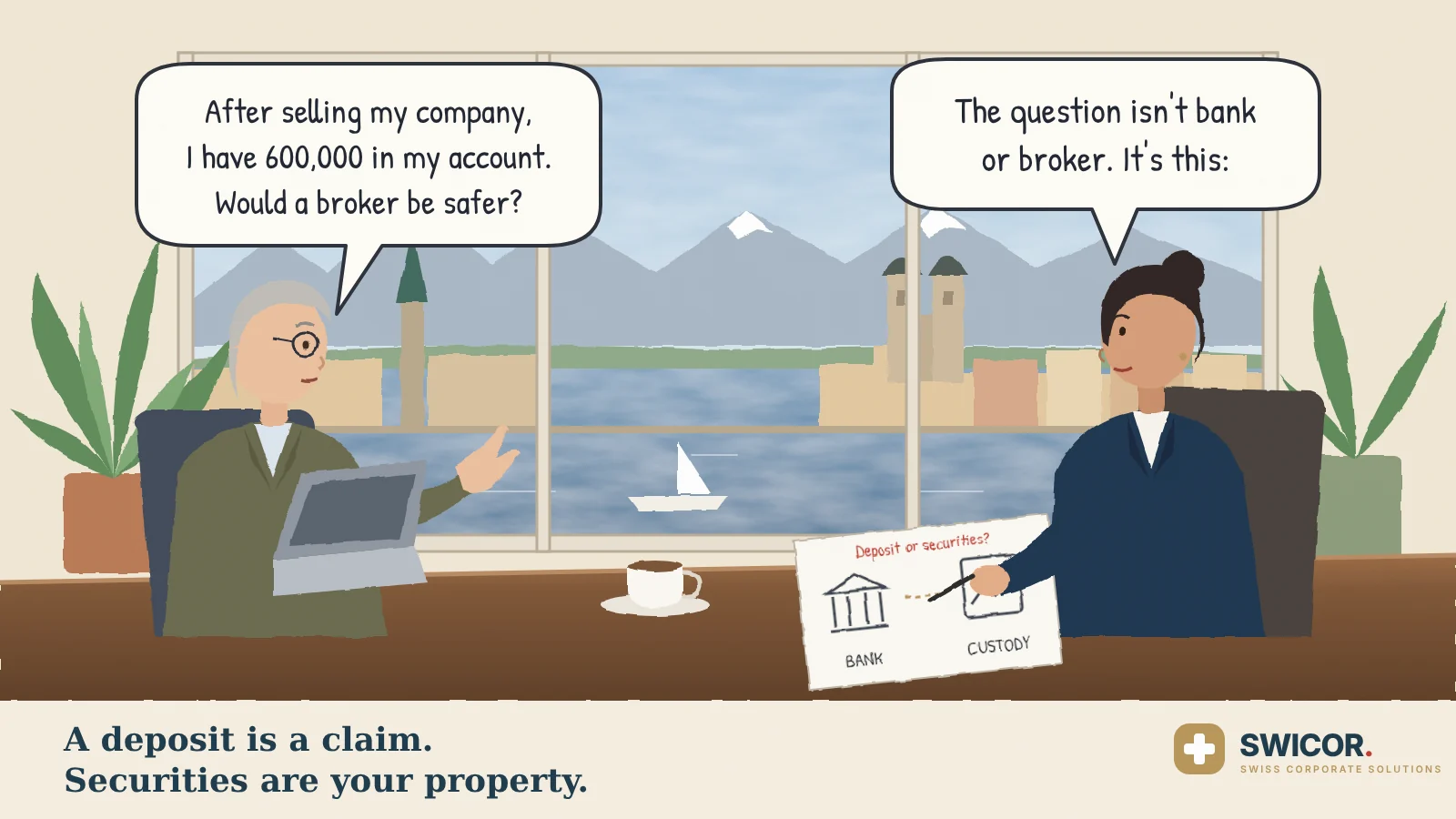
- ✛A deposit is a claim: if the bank fails, you are a creditor. Only what deposit insurance covers is protected – EUR 100,000 per person and bank in the EU.
- ✛Securities are your property: shares, ETFs and bonds in custody are segregated and returned in insolvency – at a bank just as at a broker.
- ✛Cash at a broker is often less protected than at a bank: EU investor compensation usually pays only 90% of the loss, up to EUR 20,000.
- ✛Swissquote is a bank: cash there is a bank deposit, protected up to CHF 100,000. The ‘broker instead of bank’ comparison does not apply.
- ✛Read the ratios: EU banks average a 16.1% CET1 ratio but only a 5.8% leverage ratio. Both belong in the assessment.
- ✛Spread rather than hope: larger sums across several institutions and countries, liquidity reserves in money-market ETFs or short-term government bonds in custody.
What happened at ueno bank
On 3 November 2026, Paraguay’s central bank placed ueno bank under supervision and dissolved it. The app was blocked and cards stopped working. Around 2.9 million customers were affected, about 60% of the adult population. The bank held almost 9% of all deposits in the country.
According to the regulator, the trigger was loans to companies linked to the owning family. In June, a USD 74 million loan portfolio was also transferred to a related company that apparently received the money for it indirectly from the bank itself. In the end, the solvency ratio was below half the legal minimum. Government bodies and the social security fund IPS also had hundreds of millions of US dollars there.
For savers this means: deposit insurance initially paid out up to 10 million guaraní per person, about USD 1,675. According to media reports, the guarantee fund covers up to 40 minimum wages in total, about USD 19,800. Anything above that depends on liquidating the bank and can take years. Our article on the bank failure in Paraguay explains the background.
The core lesson from Paraguay applies everywhere: a bank deposit is a loan you give the bank. The more you hold above deposit insurance, the more your money depends on the creditworthiness of a single institution.
Deposits or securities: the real difference
Anyone asking whether their money is safe at a broker is really asking the wrong question. What matters is what sits in the account.
A bank deposit legally belongs to the bank. It owes you the amount. If it fails, you queue up as a creditor. Only what deposit insurance covers is protected.
Securities in custody remain your property. The bank or broker only holds them. In Germany, the Custody Act ensures they do not form part of the insolvency estate. They are segregated and returned to you or transferred to another institution. Comparable rules apply in Switzerland and the EU. This is the same at a savings bank as at an online broker.

Some residual risk remains with custody too. If an institution misuses client assets or its records are wrong, shortfalls can occur. That is what investor compensation is for. And even if everything comes back in the end, the process can take time. Clients of Lehman’s London subsidiary waited years for some of their securities after 2008.
Is your money safe at a broker? What applies to cash in a broker account
This is where the most common mistake lies. Many people park larger sums as cash in their broker’s settlement account because they consider the broker safer than the bank. Legally, this is often the weakest option.
| Provider / situation | Cash protection | Limit |
|---|---|---|
| Bank in Germany or the EU | Statutory deposit insurance, payout within 7 working days | EUR 100,000 per person and bank |
| Private bank in Germany with deposit protection fund | Additional voluntary protection | up to EUR 3 million, EUR 1 million from 2030 |
| Bank in Switzerland (including Swissquote) | esisuisse | CHF 100,000 per person and bank |
| Investment firm in the EU (e.g. Interactive Brokers Ireland) | Segregated client money, investor compensation | 90% of the loss, max. EUR 20,000 |
| US broker with SIPC (e.g. Interactive Brokers LLC) | SIPC, partly additional insurance | USD 500,000, of which USD 250,000 cash |
Segregated client money is not part of the broker’s own assets. But it sits in accounts at banks, and their failure then hits all of the broker’s clients together. For larger liquidity reserves, a money-market ETF or a short-term government bond in custody is usually better protected than cash in the settlement account.
And the big brokers?
Interactive Brokers reported around 5.6 million client accounts, USD 965 billion in client assets and USD 23.3 billion in equity for the third quarter of 2026. That is solid. Swissquote reached CHF 96.3 billion in client assets and a capital ratio of 25.2% at the end of June 2026. Both are well-capitalised firms. But size and capital do not replace the question of whether your money sits there as a deposit or as securities, and which entity of the group is your contractual partner.
CET1 ratio, leverage ratio and what they really tell you
Banks like to advertise their Common Equity Tier 1 (CET1) ratio. For EU banks it averaged 16.1% in mid-2026. This ratio relates capital to risk-weighted assets. A loan to a government or a mortgage with a low risk weight counts only fractionally.
The unweighted leverage ratio paints a soberer picture: it stood at 5.8% in the same period, against a legal minimum of 3%. A bank can therefore have more than 17 times as much balance sheet as equity. That is not a scandal; it is the business model. But it explains why crises of confidence escalate so quickly at banks.
A third figure is often overlooked: the liquidity coverage ratio (LCR). For EU banks it recently stood at almost 126%. ueno bank shows that clean-looking ratios are of little use when loans to related companies hollow out the balance sheet. Good ratios are necessary, but not sufficient.
Deposit insurance: better than its reputation, but limited
Deposit guarantee funds only hold a small share of covered deposits. The EU target is 0.8%. In a large systemic crisis that is not enough. But concluding that deposit insurance is useless would be wrong. In individual failures it has paid reliably in Europe so far, and in systemic crises states have always stepped in.
In Germany, two special features add to statutory protection. Savings banks and cooperative banks protect each other through their networks. Private banks have a voluntary deposit protection fund that has covered up to EUR 3 million per private client since 2025 and will cover up to EUR 1 million from 2030.
Outside Europe, things often look different. In Paraguay it is about USD 19,800, in many countries even less. Anyone using a bank account outside the EU should know the local protection and only hold as much there as the account’s purpose requires. Smaller offshore banks can also come under pressure quickly: Euro Pacific Bank in Puerto Rico was closed by the regulator in 2022, even though it advertised that it barely lent out deposits.
The SWICOR check: six questions for every institution
Rather than relying on a league table with scores, we recommend six questions. They can be answered for any bank and any broker and quickly show where the risk lies:
- 1What sits there? Deposits or securities? For deposits, deposit insurance counts; for securities, custody.
- 2Who is your contractual partner? In international groups often not the parent company but a subsidiary in Ireland, Luxembourg or Cyprus – with that country’s protection.
- 3Which protection applies? Deposit insurance, investor compensation or SIPC – and up to what limit?
- 4How is the institution positioned? CET1 ratio, leverage ratio, liquidity, rating, business model. A broker without a lending business has a different risk profile from a lending bank.
- 5How concentrated are you? Holding more than the deposit insurance limit at a single bank is a conscious risk.
- 6Can you get to your money? Account freezes after KYC reviews, technical outages or sanctions filters can do as much damage as a failure. Our article on offshore account mistakes describes typical pitfalls.
An example: 600,000 after selling a company
Markus, 58, has sold his company. Suddenly EUR 600,000 sits in the business account at his local bank. He wants to put the money into real estate and a new project in two years. Until then it should be safe and available. One possible split, expressly not investment advice:
| Component | Amount | Rationale |
|---|---|---|
| Current account at local bank | EUR 50,000 | Ongoing payments, fully covered by deposit insurance |
| Savings account at a second bank | EUR 90,000 | Reserve, covered, different banking group |
| Account at a Swiss bank | CHF equivalent of EUR 80,000 | Second country, second currency, esisuisse |
| Money-market ETF in custody | EUR 300,000 | Segregated, yields close to the ECB deposit rate of 2.50% |
| Short-term German government bonds in custody | EUR 80,000 | Sovereign risk instead of bank risk, fixed maturity |
The result: not a single euro depends unprotected on one bank. The return is close to money-market rates, while the average savings rate recently sat well below that. Gold or crypto can be an addition, but are too volatile for a liquidity reserve with a fixed purpose. Anyone holding crypto in self-custody should know the CARF reporting rules.
What marketing for ‘safe’ structures leaves out
Many league tables currently circulate online that score banks and brokers and sell the matching account opening at the same time. Three points deserve critical scrutiny:
- ✛Self-made indices: a score without a disclosed data basis is marketing, not analysis.
- ✛High interest in local currency: 6 to 8% at banks in small countries sounds good, but includes currency and credit risks that can quickly eat up the interest.
- ✛Accounts without CRS reporting: they do not change your tax liability. Investment income must be declared in your country of residence. More in our list of countries without CRS.
International diversification makes sense; that is the core of flag theory. But it only works with reputable institutions, proper declaration and a clear purpose for each account. Proven options include a bank account in Switzerland or an account in Georgia as a second pillar.
Want to spread your liquidity across several banks and countries?
Bank account abroad →The bottom line
Is your money safe at a broker? Securities, yes – as a rule even safer than a large bank deposit. Cash at a broker, on the other hand, is often less safe than at a bank. The failure of ueno bank showed how quickly deposits above the insurance limit become a problem. It did not show that banks are inherently unsafe.
Anyone wanting to protect their wealth keeps only what they need or what is insured in bank accounts, holds larger reserves as securities in custody and spreads both across several institutions and countries. We are happy to help, from a Swiss bank to an account in Georgia.
Frequently asked questions
Is my money safe at a broker?
Securities in custody are segregated and returned to you in insolvency. Cash in a broker account, by contrast, is often only protected through investor compensation, in the EU usually up to EUR 20,000.
Is money safer at a broker than at a bank?
For securities yes, for cash usually not. Bank deposits are protected up to EUR 100,000 per bank in the EU, cash at an investment firm usually much less.
What happens to my ETFs if my broker goes bust?
They belong to you and do not form part of the insolvency estate. The administrator transfers them to another institution or returns them. That can take time, though.
Is Swissquote a bank or a broker?
Swissquote is a Swiss bank with a banking licence. Cash there is a bank deposit protected up to CHF 100,000 by esisuisse; securities are held separately.
How much money should I keep at one bank at most?
As a rule of thumb, no more than deposit insurance covers, i.e. EUR 100,000 or CHF 100,000 per person and bank. Larger reserves belong spread across several banks or held as securities in custody.
What happened to ueno bank’s savers?
Paraguay’s central bank dissolved the bank on 3 November 2026. Savers initially received up to about USD 1,675; according to reports, deposit insurance covers up to about USD 19,800. Higher amounts depend on the liquidation.
Spread your liquidity safely
We help you open accounts at solid banks in several countries – matched to your residence, tax status and the purpose of each account.
This article is a general analysis and does not replace individual tax or legal advice. Regulations change; the information reflects the status at the date of publication.