Place of Effective Management: Why Germany Taxes Your English Ltd – and Which Structures Work Legally
‘But my company is in London.’ We hear that sentence a lot, usually shortly after a letter from the tax office has arrived. For German tax, though, what counts is not where the Ltd is registered but where it is actually run. If the place of effective management is in Germany, the company is taxable here on its entire profit. We show how the tax office checks this, what it can cost retrospectively and which structures with an English Ltd or LLP genuinely save tax legally.
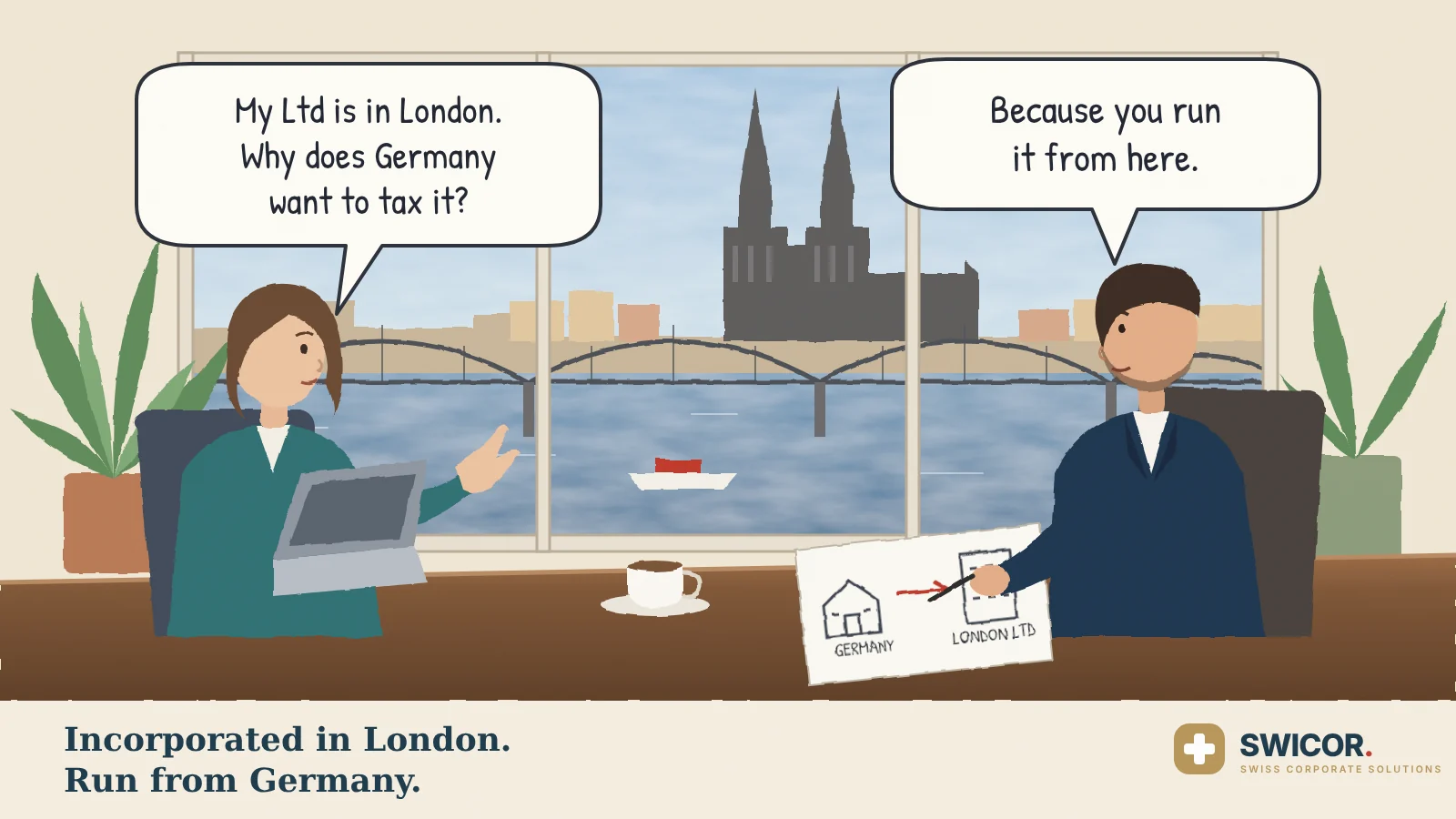
- ✛What matters is the place of effective management under Section 10 of the German Fiscal Code: where day-to-day decisions are made. A home office in Germany is enough.
- ✛If it is in Germany, the Ltd is fully taxable here – corporate and trade tax on worldwide profit, about 30% in total.
- ✛The UK–Germany tax treaty allocates dual-resident companies to the state of effective management (Art. 4(3)). London does not help then.
- ✛Since Brexit, an Ltd run from Germany counts under civil law as a partnership or sole proprietorship. The shareholders are personally liable.
- ✛An English Ltd itself always pays 19 to 25% UK corporation tax. Far less is only possible if you no longer live in Germany yourself.
- ✛0% is legally possible with a UK LLP whose partners live and work outside the UK and Germany – with genuine substance and proper documentation.
A typical case from our practice
Jana is a web developer. Three years ago she set up an Ltd in London online, for about GBP 50 in an afternoon. Registered office with a service provider in Shoreditch, business account at a fintech bank, clients in Germany, Austria and the Netherlands. She worked the whole time at her desk in Cologne-Ehrenfeld.
Her assumption was simple: the company is English, so it pays English tax. 19% on small profits sounded better than German corporate and trade tax. Then came the tax audit, triggered by a cross-check of her client invoices. The auditor’s question was short: ‘Who makes the decisions in this company, and where?’
Italy expressly rewrote its rules on this in 2024. In Germany the principle has applied for decades. It sits in a single short section of the Fiscal Code.
Place of effective management: how the German tax office checks
Section 10 of the Fiscal Code defines management as the ‘centre of the top-level business management’. Case law has made this concrete: what counts is the place where the will decisive for running the business is formed. The Federal Court of Justice summarised the criteria again in 2019 in a criminal tax case concerning an English company (decision of 13 March 2019, 1 StR 520/18):
- ✛What matters are day-to-day operations: accepting orders, setting prices, signing contracts, approving payments, managing staff.
- ✛Fundamental decisions by the shareholders, such as how profits are used, do not count.
- ✛No dedicated office is needed. The managing director’s home can also be the place of management.
- ✛If several equal directors work in different places, there can be several places of management.
- ✛The overall picture counts. Where bookkeeping and payments actually run can point one way or the other.
For Jana this means: she is the sole director, she decides everything, and she sits in Cologne. One board meeting a year by video call with minutes saying ‘London’ changes nothing. The tax office does not look at the minutes; it looks at her laptop, her emails and her travel records.
Unlike Italy since 2024, Germany has no list of several criteria. There is exactly one test, and it targets the operating business. For one-person companies the place of effective management therefore almost always coincides with the owner’s home.
What the Ltd then pays in Germany
If management is in Germany, the Ltd is fully subject to corporate tax under Section 1(1) of the Corporate Tax Act, on its worldwide income. In a letter of 19 July 2023 the Federal Ministry of Finance confirmed that such an Ltd still counts as a corporation for tax purposes as long as it remains on the UK register.
| Tax | Consequence |
|---|---|
| Corporate tax | 15% plus solidarity surcharge, 15.825% in total on the entire profit |
| Trade tax | The place of management is a permanent establishment (Sec. 12 Fiscal Code). About 14% at a multiplier of 400% |
| VAT | Services are supplied from Germany; the Ltd needs a German tax number |
| Distributions | 26.375% flat tax incl. surcharge for a shareholder resident in Germany |
| Back payments | Interest of 0.15% per month from the 15th month after year end, late filing surcharges |
| Criminal law | With intent, tax evasion (Sec. 370 Fiscal Code); the assessment period is then 10 years instead of 4 |
And the UK? A company incorporated there is generally UK-resident. If it is also resident in Germany, the 2010 double tax treaty decides: under Art. 4(3) the company is deemed resident only in the state where its place of effective management is situated. That is Germany. The UK obligations towards Companies House remain, but the taxing right passes to Germany. Tax already paid in London has to be reclaimed there, laboriously and within time limits.
The Brexit trap: personal liability
There is another point many Ltd owners are unaware of. Since Brexit, the seat theory applies to British companies with their administrative seat in Germany (Federal Court of Justice, II ZB 25/17). Under civil law such an Ltd is no longer a corporation but a partnership – or, with only one shareholder, simply a sole proprietorship. Limited liability falls away. For tax purposes it remains a corporation. So you get the disadvantages of both worlds.
What Jana ended up paying – and what she could have paid
Let us take an annual profit of EUR 200,000, roughly GBP 170,000. The chart shows the total burden up to distribution to the owner in four variants:

| Variant | Company level | Owner level | Total |
|---|---|---|---|
| Ltd run from Germany | Corporate + trade tax about 29.8% | 26.375% on the distribution | about 48% |
| Ltd genuinely run in the UK, owner lives in Germany | UK tax about 24.3% (with marginal relief) | 26.375% in Germany | about 44% |
| Ltd, owner moved abroad | UK tax about 24.3%, only 19% up to GBP 50,000 profit | 0% if the new country does not tax foreign dividends | about 19–25% |
| UK LLP, partners abroad, no UK business | 0% (transparent) | depends on residence, often 0% in territorial countries | down to 0% |
The second row is the sobering one for anyone who wants to stay in Germany. Even if the Ltd were properly run in London, say by a director living there with real decision-making authority, you only save a few percentage points compared with a German GmbH. In return you buy costs, coordination effort and the risk that the owner ends up deciding after all. For operating one-person companies this is practically impossible to sustain.
Legal structures: how an English Ltd really triggers less tax
The good news: there are routes that work. They all share one requirement, and it is an uncomfortable one. Anyone who lives in Germany and works from here remains taxable in Germany, whatever company sits in between.
Model 1: Ltd with residence outside Germany (19–25%)
You move your residence to a country that does not tax foreign dividends, or barely does, and run the Ltd from there or with a director in the UK. The Ltd pays UK corporation tax: 19% up to GBP 50,000 profit, 25% from GBP 250,000, tapered in between. The UK levies no withholding tax on dividends, and people not resident in the UK pay practically no UK income tax on UK dividends. The total burden is thus 19 to 25%.
You need to check two things. First, the new country of residence: some states treat a company run from their territory as resident there. Second, leaving Germany: if you hold at least 1% of the Ltd, the move triggers exit tax on hidden reserves under Section 6 of the Foreign Tax Act. Moving to a low-tax country can also trigger extended limited tax liability under Section 2. Our article on German exit taxation explains the details.
Model 2: UK LLP with partners abroad (down to 0%)
The real 0% structure is not an Ltd but a limited liability partnership. The LLP is tax-transparent in the UK. Only the partners are taxed, and in the UK only on profits from UK business. If the partners live and work in a country with territorial taxation, such as Paraguay or Panama, and the LLP earns no UK income, no tax arises either in the UK or in the country of residence.
The conditions are strict: at least two partners, no management in Germany, no permanent representative in Germany, an annual partnership tax return (SA800), identity verification at Companies House since November 2025 and a bank that understands the structure. Our articles on the UK LLP for online coaches, the step-by-step setup and the most common mistakes show how this works in practice.
Model 3: Ltd with genuine substance in the UK
For larger businesses, an Ltd with its own office, staff and management in London can make sense, for instance as a sales company for the UK market. Tax-wise this brings little compared with Germany, but it can still make business sense. It is then important that German employees or shareholders do not de facto run the Ltd, otherwise a German permanent establishment arises after all. Many know this risk from the debate about the permanent representative.
Running an Ltd from Germany or planning a structure with a change of residence?
Company formation England →If it has already happened: what to do now
Anyone running an Ltd from Germany today should not wait for the auditor to ring the bell. The sooner you act, the more options you have.
- 1Take stock: who decided what, when and where? Contracts, emails, travel, payment approvals. Honestly, not the way you would like it to have been.
- 2Quantify the tax consequences: corporate, trade tax and VAT for the open years, interest, double taxation with the UK.
- 3Consider a correction: where the misjudgement was unintentional, a correction is often enough. With intent, a voluntary disclosure that avoids penalties may be the right route, but only as long as no audit has been announced.
- 4Decide on the structure: conversion into a German GmbH, orderly wind-up of the Ltd or a genuine restructuring with a change of residence.
- 5Do not rush the strike-off: an Ltd struck off the UK register loses its existence for tax purposes. That can trigger final taxation of hidden reserves.
For Jana the solution in the end was a German GmbH for the ongoing business and a plan to move to Portugal in two years. The back payment for three years hurt, but it was manageable because she reacted early.
The bottom line
An English Ltd is a solid tool, but not a tax-saving model for people who live and work in Germany. The place of effective management follows you to your desk. Anyone who really wants to pay less tax has to organise their own residence and the management of the company outside Germany. With an Ltd, 19 to 25% is then realistic; with an LLP and the right country of residence, 0% too.
Which model suits you depends on your business, your clients and your life plans. The comparison of UK LLP, Hong Kong and EU structures gives an overview of the alternatives, and our article on UK taxes provides background on the British tax system. For your specific case, our tax optimisation service is available.
Frequently asked questions
What does place of effective management mean?
Under Section 10 of the German Fiscal Code it is the centre of top-level business management, i.e. the place where day-to-day business decisions are made. It can also be the managing director’s home.
Is my English Ltd taxable in Germany?
Yes, if you run the Ltd from Germany. It is then fully subject to corporate tax and usually trade tax, about 30% of profit in total.
Does a director in London help?
Only if they actually make the day-to-day decisions. A nominee director who signs what you dictate does not move the place of effective management.
What tax does an Ltd pay in the UK?
19% on profits up to GBP 50,000, 25% from GBP 250,000, tapered in between through marginal relief. There is no UK withholding tax on dividends.
Can you legally pay 0% tax with a UK company?
With a UK LLP, yes, if the partners live and work outside the UK and Germany, no UK income arises and the country of residence does not tax foreign income. An Ltd, by contrast, always pays UK corporation tax.
What happens under civil law to an Ltd run from Germany?
Since Brexit it is treated under the seat theory as a partnership or sole proprietorship. Limited liability falls away, but for tax purposes it remains a corporation.
Check your Ltd before the auditor does
We analyse where your company is actually run, quantify the risks and build a structure with you that fits your residence, business and life plans.
This article is a general analysis and does not replace individual tax or legal advice. Regulations change; the information reflects the status at the date of publication.