Territorial Taxation 2026: How the Territorial Principle Works – Countries, Rules and Limits for Entrepreneurs
Under territorial taxation, a state taxes only income arising within its territory. Foreign profits remain tax-free. That sounds simple, but in practice it is complex: hardly any country still applies the principle in its pure form. Hong Kong, Singapore and Malaysia have tightened their rules since 2022, and CFC rules and the global minimum tax deliberately override the principle. For individuals from Germany, Austria or Switzerland, a territorial country only helps if they actually move their residence there. This guide reflects the 2026 position.
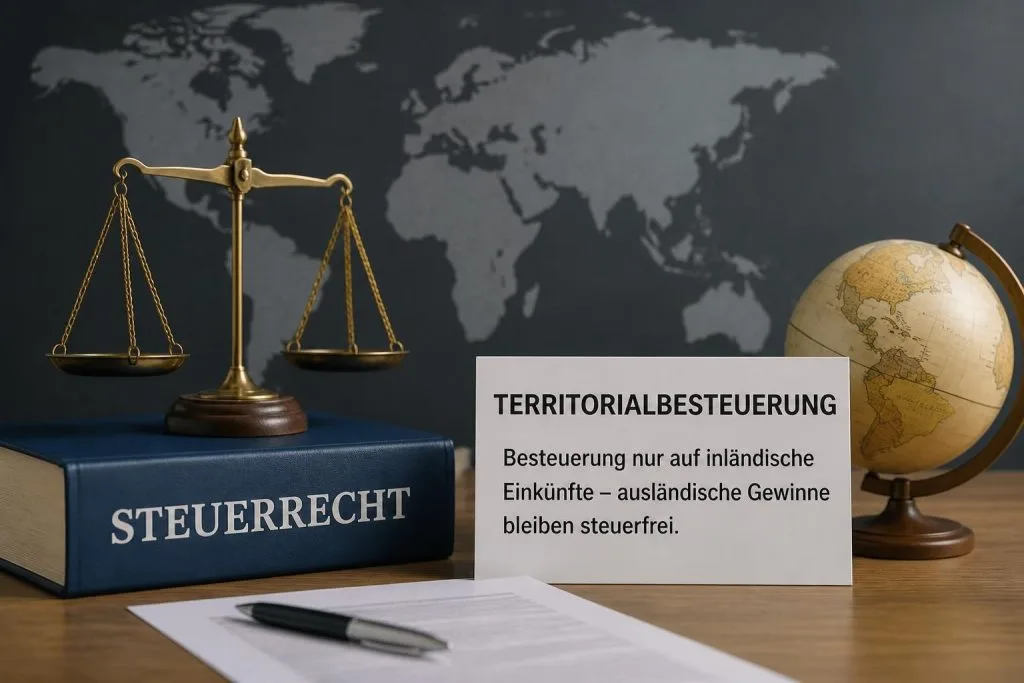
- ✛Territorial taxation means only domestic-source income is taxed. What matters is where the profit-generating activity takes place – not where the money is received.
- ✛Pure territorial systems have become rare. Since 2023 Hong Kong taxes certain foreign income of group companies without substance, and since 2022 Malaysia taxes foreign income remitted to Malaysia.
- ✛High-tax countries also have territorial elements: the Swiss participation deduction, section 8b KStG in Germany and the Dutch participation exemption – each with minimum holdings.
- ✛CFC rules (in Germany below 15%) and Pillar Two (15% for groups with revenue of EUR 750m or more) limit the benefits.
- ✛For individuals, a territorial country only works with a genuine move. Anyone keeping a home in Germany remains taxable there on worldwide income.
What is territorial taxation?
Most states combine two connecting factors: they tax residents on their worldwide income and non-residents on their domestic income. Under territorial taxation, the first part largely falls away. The state only taxes income whose source lies in its territory – regardless of whether the taxpayer is resident there.
| Feature | Territorial taxation | Worldwide taxation |
|---|---|---|
| Taxed | domestic-source income | all income worldwide |
| Foreign profits | tax-free (sometimes with conditions) | taxable, double taxation avoided by credit or exemption |
| Key question | Where is the source? | Where is the taxpayer resident? |
| Anti-abuse | source rules, increasingly substance tests | CFC rules, exit taxes |
| Examples 2026 | Hong Kong, Panama, Paraguay, Costa Rica, Georgia (individuals) | Germany, Austria, Switzerland, France, US (individuals) |
A variant is the remittance basis: foreign income is only taxed when remitted into the country. Singapore, Malta and Cyprus (for non-doms) use such elements. The Tax Foundation analyses the design options of territorial systems and their effects on revenue and competitiveness.
Source rules: where does income arise?
The territorial principle stands or falls with the source question. Each country defines it itself – and that is where the practical differences lie.
| Type of income | Typical source rule | Note |
|---|---|---|
| Trading and services | place of the profit-generating activity (Hong Kong: operations test) | performing the service locally creates domestic income – even with foreign clients |
| Interest | place where funds are provided or debtor's seat | varies by country |
| Dividends | seat of the distributing company | often also exempt |
| Royalties | place of use or place of development | with substance requirements since BEPS |
| Real estate | location of the property | practically without exception |
The most common mistake: 'My client is abroad, so the income is foreign.' In Hong Kong, Paraguay or Panama, what usually counts is where you work. Anyone performing services locally has domestic income.
Countries with territorial taxation in 2026
| Country | Companies | Individuals | Status 2026 |
|---|---|---|---|
| Hong Kong | 8.25% up to HKD 2m, then 16.5% on Hong Kong profits | only Hong Kong income, max. 15% or 16% | FSIE regime since 2023: certain foreign income of group companies taxable |
| Singapore | 17% on domestic and remitted income | remitted foreign income mostly exempt | modified territorial system, section 10L since 2024 |
| Malaysia | 24% | remitted foreign income exempt until 2036 (conditions) | remitted foreign income taxed since 2022 |
| Panama | 25% on Panamanian income | only Panamanian income | pure territorial system; on the EU list of non-cooperative jurisdictions |
| Costa Rica | 30% on Costa Rican income | only Costa Rican income | territorial; worldwide reforms under discussion |
| Paraguay | 10% (IRE); certain foreign financial income included | 8–10% only on Paraguayan income | Law 6380/2019 |
| Uruguay | 25% | new residents: foreign capital income exempt for 11 years | partial taxation of certain foreign capital income since 2020 |
| Georgia | Estonian model: 15% only on distribution | foreign income tax-free | territorial for individuals only |

Hong Kong: operations test and FSIE
Hong Kong is the flagship model: only profits from activities in Hong Kong are taxed. Since 1 January 2023 (extended in 2024), however, the foreign-sourced income exemption regime (FSIE) applies. Foreign dividends, interest, disposal gains and IP income received in Hong Kong by an entity of a multinational group are only exempt if it has adequate substance in Hong Kong or the participation exemption (at least 5%, 12 months) applies. More in our article on Hong Kong, Pillar Two and digital income.
Singapore and Malaysia
Singapore only taxes foreign income on remittance and exempts dividends, branch profits and service income if they were subject to a headline rate of at least 15% abroad. Since 2024, section 10L taxes gains on foreign assets without substance. Details in our article on Singapore taxes. Malaysia abolished the exemption for remitted foreign income in 2022; dividends are exempt until 2036 under conditions. The common claim 'Malaysia: 0% from 2022' is therefore wrong.
Panama, Paraguay and Georgia
Panama still only taxes Panamanian income. For banks, business partners and treaties, however, being on the EU list of non-cooperative jurisdictions is a disadvantage. Paraguay is territorial for individuals; since 2020 companies must pay tax on certain foreign interest and dividends, see moving to Paraguay. Georgia exempts foreign income of individuals; companies pay 15% under the Estonian model only on distribution. With company formation in Georgia, internationally active businesses therefore benefit mainly from deferred taxation and, for sole traders, from small business status with a 1% turnover tax.
Territorial elements in high-tax countries
Worldwide tax states also largely exempt participation income and foreign permanent establishments. For companies they thus work territorially – but only under conditions.
| Country | Rule | Requirements |
|---|---|---|
| Switzerland | participation deduction: profit tax reduced in proportion of participation income to total profit; foreign PEs and real estate excluded | at least 10% or CHF 1m fair value; capital gains with at least 10% and 1 year holding |
| Germany | section 8b KStG: 95% of dividends and capital gains exempt; treaty exemption for PEs | dividends only from 10% holding; trade tax participation privilege from 15% |
| Netherlands | participation exemption: full exemption | at least 5%, not a mere portfolio holding |
| France | régime mère-fille: 95% exemption; foreign branch profits outside the tax base | at least 5%, 2-year holding |
| US | dividend exemption since 2017 (section 245A IRC) | combined with minimum tax on foreign profits (GILTI, NCTI from 2026) |
The KPMG analysis of the Swiss tax system shows how the participation deduction effectively leads to largely tax-free participation income. The often-quoted '95% tax-free' does not apply to Switzerland, however – that is the German rule. Swiss cantons are described in Swiss taxes by canton, the German holding in GmbH taxes.
Individuals: a territorial country alone is not enough
For individuals, territorial taxation is particularly attractive: anyone resident in Paraguay, Panama or Georgia pays no tax there on foreign income. The effect only materialises if the previous country of residence no longer taxes.
- ✛Residence in the home country: in Germany an available home (section 8 AO) is enough for unlimited tax liability on worldwide income.
- ✛No double tax treaty: Germany has no treaty with Paraguay, Panama or Costa Rica. In the case of dual residence there is no tie-breaker rule.
- ✛Extended limited tax liability (section 2 AStG): Germans who move to a low-tax country and keep substantial economic interests in Germany remain subject to extended tax for up to ten years.
- ✛Exit tax (section 6 AStG): for shareholdings of 1% or more in corporations, the increase in value is taxed on departure.
What to do when leaving is explained in our articles on emigrating and flag theory. SWICOR supports residence in a territorial country under residency abroad.
Companies: holding, IP and services
Holding structures
A holding company in a country with territorial taxation or a participation exemption can receive dividends and capital gains tax-free. Withholding taxes in the subsidiary's country, double tax treaties, the EU Parent-Subsidiary Directive and substance are decisive. A country without a treaty network – such as Panama or Paraguay – is therefore rarely suitable as a holding location for European subsidiaries. A comparison is in UK LLP vs Hong Kong vs EU.
IP and licences
Since BEPS Action 5, IP benefits are only granted under the nexus approach: only IP developed in the country concerned qualifies. Hong Kong's FSIE regime follows the same idea. Transferring existing IP from Germany can also trigger German exit taxation.
Services and remote work
A Hong Kong consultancy pays no profits tax on services performed entirely outside Hong Kong. That does not mean the profits are taxable nowhere: where the consultants actually work, a permanent establishment may arise. The Chambers analysis of international tax systems describes permanent establishment issues in cross-border services. How quickly a foreign company becomes taxable in Germany is shown in our article on permanent representatives and CFC taxation.
The Oxford study on territorial taxation examines at firm level how territorial and worldwide systems affect the competitiveness of multinationals.
Considering a territorial country for residence or company? We analyse source rules, CFC rules and substance – OECD-compliant and remote.
Tax optimisation →Limits: CFC rules, Pillar Two and transparency
CFC rules
CFC rules deliberately override the territorial principle. In Germany, passive income of a foreign company taxed at less than 15% is attributed to the shareholder (sections 7–13 AStG). For EU states, the Anti-Tax Avoidance Directive (ATAD) requires such rules. The European Commission documents the development of anti-abuse rules in member states.
Global minimum tax
Since 2024 EU states have levied the income inclusion rule (IIR), and since 2025 the undertaxed profits rule (UTPR). Groups with revenue of EUR 750m or more thus pay at least 15% – including on profits in territorial countries. Many countries, including Hong Kong and Singapore, have therefore levied a domestic top-up tax since 2025. In January 2026 the OECD Inclusive Framework adopted a 'side-by-side' package exempting US groups from the IIR and UTPR. Pillar Two does not apply to SMEs and entrepreneurs.
Transparency
- ✛CRS: banks in more than 120 states report account data to the country of residence – including from territorial countries such as Hong Kong, Panama or Costa Rica.
- ✛Public country-by-country reporting: in the EU from financial year 2024 for groups with revenue of EUR 750m or more
- ✛DAC6: reporting of cross-border tax arrangements in the EU
- ✛Beneficial ownership registers: mandatory in most jurisdictions
What the tax office learns about foreign accounts in 2026 is shown in our article on foreign accounts and the tax office.
Substance: what holds a territorial structure up
- ✛Local management: board meetings and strategic decisions in the territorial country, with minutes
- ✛Qualified staff: appropriate to the activity – not just a nominee director
- ✛Premises and expenses: an office actually used, appropriate local costs
- ✛Transfer pricing: arm's length remuneration for services between related parties
- ✛Documentation: keep complete records of contracts, invoices, travel and places of work
SWICOR provides a local director under board and director, the business address under registered address service and ongoing accounting under accounting and tax.
Implementation in five steps and costs
- 1Analysis: record income types, places of work, shareholders and residence
- 2Check the country of residence: CFC rules, place of management, exit and exit taxation consequences
- 3Choose the jurisdiction: compare source rules, treaty network, banking access, EU lists and reputation
- 4Build the structure: form the company, create substance, set transfer prices
- 5Document continuously: review substance and tax positions every year
| Cost item | One-off (EUR) | Ongoing per year (EUR) |
|---|---|---|
| Formation and registration | 2,000 – 25,000 | 1,000 – 5,000 |
| Substance (office, staff, director) | 5,000 – 50,000 | 20,000 – 200,000 |
| Tax and legal advice | 5,000 – 50,000 | 5,000 – 50,000 |
| Accounting, audit, compliance | 1,000 – 10,000 | 5,000 – 40,000 |
The range is wide: a company for a sole entrepreneur genuinely resident in the territorial country costs only a fraction of a group holding with its own staff. SWICOR offers company formation in territorial jurisdictions including Hong Kong, Panama and Singapore.
Outlook: where the territorial principle is heading
The line between territorial and worldwide systems is blurring. Territorial countries are introducing substance tests and top-up taxes, while worldwide countries exempt participation income. At the same time, the OECD's plans to reallocate taxing rights to market states (Pillar One, Amount A) have stalled; many states levy their own digital services taxes instead.
For entrepreneurs this means: the choice of country remains important but is not decisive on its own. Where work is done and decisions are taken weighs more than the company's address.
Conclusion
In 2026, territorial taxation still offers real advantages – above all for individuals genuinely resident in countries such as Paraguay, Panama or Georgia and for companies with substance in Hong Kong or Singapore. Pure territorial systems have become rare, however, and CFC rules, Pillar Two and automatic exchange of information set clear limits. Success comes from planning source, residence and substance together.
SWICOR . SWISS CORPORATE SOLUTIONS supports you with analysing your situation, choosing the right jurisdiction, company formation and ongoing tax optimisation – fully remote and at transparent fixed prices.
Frequently asked questions
What does territorial taxation mean?
A state only taxes income whose source lies in its territory. Foreign income remains tax-free, regardless of whether the taxpayer is resident in the country.
Which countries have a territorial system in 2026?
Among others Hong Kong, Panama, Costa Rica and Paraguay. Singapore uses a modified system, and Georgia is territorial for individuals. Malaysia has taxed remitted foreign income since 2022.
Is foreign income always tax-free in Hong Kong?
No. Since 2023, certain foreign income of multinational group entities is taxable when received in Hong Kong unless there is adequate substance or the participation exemption applies.
Will I save tax by moving to a territorial country?
Only if you are no longer taxable in your previous country of residence. In Germany an available home is enough for unlimited tax liability; sections 2 and 6 AStG may also apply.
Is the Swiss participation deduction a form of territorial taxation?
It works similarly for participation income. From 10% or CHF 1m fair value, profit tax is reduced in proportion to participation income. Switzerland nevertheless taxes residents on worldwide income in principle.
Does Pillar Two also apply in territorial countries?
For groups with revenue of EUR 750m or more, yes: other states or the territorial country itself collect the difference to 15%. Small and medium-sized businesses are not affected.
Use territorial taxation for your situation?
We review source rules, residence, CFC rules and substance and implement the right structure – remotely and at fixed prices.
This article is a general analysis and does not replace individual tax or legal advice. Regulations change; the information reflects the status at the date of publication.