Crypto Taxes in Germany 2026: Holding Period, Exemption Limit, Staking and the Planned Reform from 2027
Crypto taxes in Germany apply when you sell, swap or spend bitcoin and other crypto assets at a profit within one year of buying them. After more than one year, the gain on private assets remains tax-free – for now. A draft bill from the Federal Ministry of Finance proposes a 25% flat tax from 2027 on newly acquired coins. This guide explains crypto taxes in Germany under current law, shows the planned changes and where entrepreneurs with international ties need to look closely.
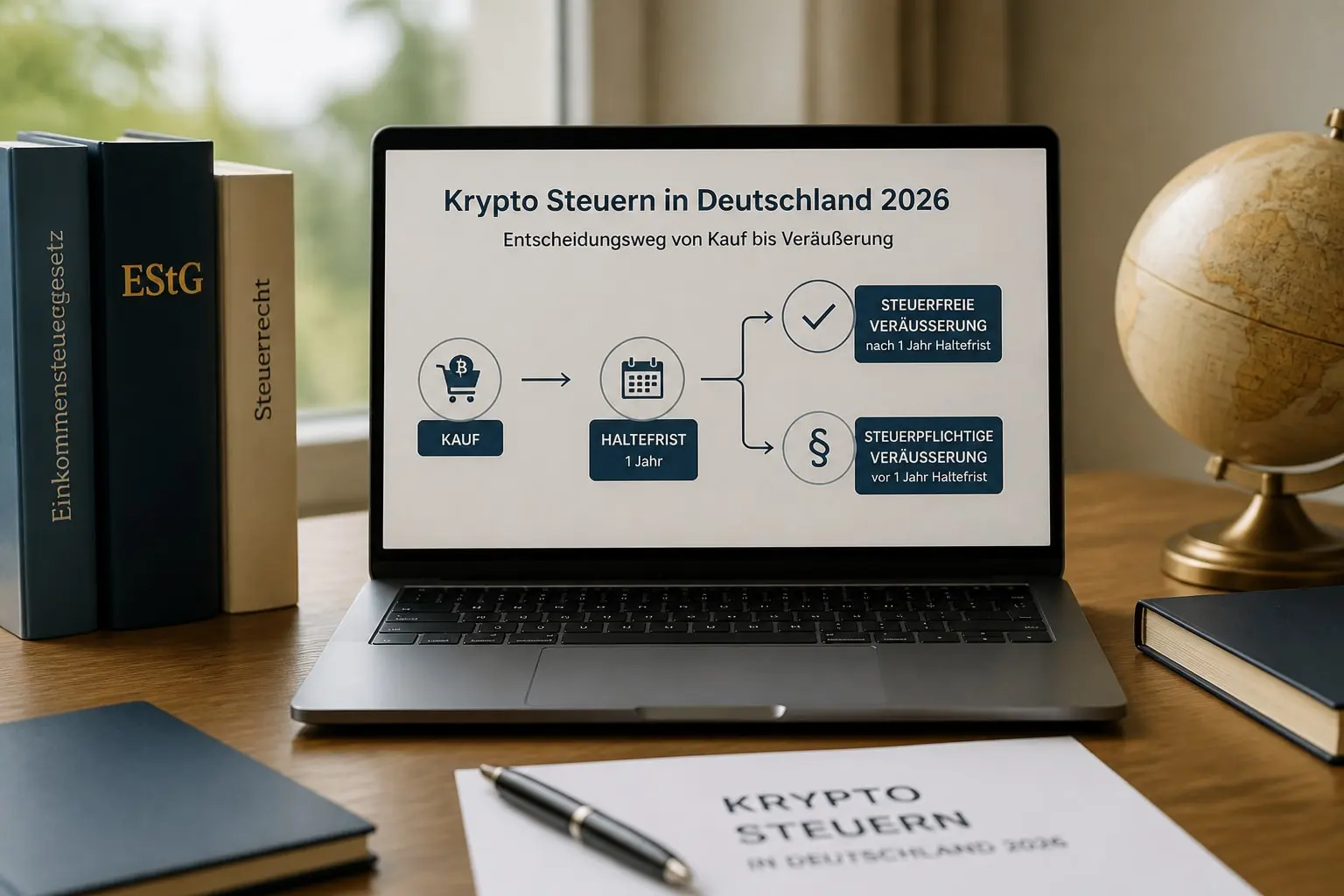
- ✛Gains from selling crypto are private disposal transactions (§ 23 EStG) taxed at the personal rate of up to 45% – but only within the one-year holding period.
- ✛The exemption limit is less than EUR 1,000 per person per year. From EUR 1,000, the entire gain is taxable.
- ✛Staking, lending and mining income is other income (§ 22 No. 3 EStG) with its own exemption limit of less than EUR 256. There is no ten-year holding period.
- ✛Since 1 January 2026, crypto service providers record your transactions (DAC8 / KStTG). The first report to the Federal Central Tax Office is due by 31 July 2027.
- ✛Planned but not adopted: a 25% flat tax from 1 January 2027 for crypto acquired after 31 December 2026; withholding by exchanges from 2028.
How do crypto taxes work in Germany?
For tax purposes, crypto assets are "other assets". Selling them from private assets is a private disposal transaction under § 23(1) No. 2 EStG. Unlike shares, there is currently no flat withholding tax: your gain is added to your other income and taxed at your personal rate. The Federal Fiscal Court confirmed this in its ruling of 14 February 2023 (IX R 3/22).
The administrative position is set out in the updated letter of the Federal Ministry of Finance of 6 March 2025 on the income tax treatment of crypto assets. It binds tax offices and also introduces new record-keeping and cooperation duties. Three questions decide your crypto taxes:
- ✛How long did you hold the crypto asset?
- ✛How high is your total gain from private disposals in the calendar year?
- ✛Is it a sale or ongoing income such as staking rewards?
Do I have to pay tax on bitcoin gains?
Yes, if you sell bitcoin at a profit within twelve months of acquisition and reach the exemption limit. If you hold for more than a year, under current law you pay no income tax on the gain – regardless of its size.
Since the 2024 tax year, total gains from private disposals are tax-free if they are less than EUR 1,000 (previously EUR 600). It is an exemption limit, not an allowance: at EUR 999 you pay nothing, at EUR 1,000 the full amount is taxable. With joint assessment, each spouse has their own limit for their own gains; it cannot be transferred. The limit applies to all private disposals together, such as crypto and gold.

What counts as a disposal for tax purposes?
Not only a sale for euros, but any transaction in which you give up a crypto asset in return for something. The Berlin Senate Department for Finance makes clear that swapping for another crypto asset or for goods and services is also a disposal. Typical taxable events:
- ✛Sale for euros or another fiat currency
- ✛Swapping bitcoin into ether or a stablecoin
- ✛Paying for goods or services with crypto
- ✛Wrapping, e.g. BTC into wBTC – a swap under the BMF letter, after which the holding period restarts
- ✛Using DeFi protocols where you swap into another token or lose control of the asset
Transfers between your own wallets and exchange accounts are not disposals. Document them anyway with the transaction hash so the tax office does not treat them as sales. With gifts and inheritances, the recipient takes over the holding period already elapsed.
How is the holding period calculated?
The holding period starts on the purchase date (conclusion of the contract) and ends after one year. If you sell afterwards, the gain is tax-free. Exchanges often show timestamps in UTC – allow a few days' buffer when selling just after the deadline.
If you bought coins at different times, specific identification applies in principle. Where this is not possible, the tax authorities apply FIFO per wallet: the units bought first are deemed sold first. This is usually advantageous because older coins are more likely to have passed the one-year mark.
You buy one bitcoin in February 2025 and another in October 2025. In March 2026 you sell one bitcoin. Under FIFO this is the February coin; the period has expired and the gain is tax-free. If instead you swap one bitcoin into ether in March 2026, a new period starts for the ether.
Worked example: crypto taxes on a EUR 40,000 gain
A taxable gain is added to your other income, so the burden depends on your marginal rate. The calculation in four steps:
- 01Determine the gain: sale proceeds minus acquisition costs minus transaction fees.
- 02Deduct losses from other private disposals in the same year.
- 03Check whether the EUR 1,000 exemption limit has been reached.
- 04Add the gain to taxable income.
| Other taxable income | Marginal rate on the gain | Income tax on EUR 40,000 (approx.) |
|---|---|---|
| EUR 20,000 | rises from around 25% to 42% | around EUR 14,000 |
| EUR 80,000 | 42% | around EUR 16,800 |
| EUR 300,000 | 45% | around EUR 18,000 |
Figures for single filers, 2026 tariff (basic allowance EUR 12,348, 42% from around EUR 69,900). Solidarity surcharge of 5.5% and church tax may apply. The exact figure depends on marital status and deductions.
How are staking, lending and mining taxed?
Income from staking, lending and occasional mining is other income under § 22 No. 3 EStG. The market value in euros at the time of receipt is decisive. It is tax-free if it totals less than EUR 256 per year – a separate limit, independent of the EUR 1,000 for sales.
Coins received have their own one-year holding period from receipt. The previously discussed extension to ten years for staked or lent coins does not exist; the BMF letter confirms the one-year period. Anyone running mining or validators with significant capital and a profit motive earns business income instead. Then no holding periods apply, and trade tax and bookkeeping duties are added.
Where do I report crypto gains in my tax return?
Taxable disposal gains and staking income go into Annex SO of the income tax return, as the North Rhine-Westphalia tax office describes. Crypto exchanges do not currently withhold tax – you must report gains yourself. You need:
- ✛Date, quantity and price of every acquisition
- ✛Date, quantity and proceeds of every sale or swap
- ✛Fees per transaction
- ✛Evidence of wallet transfers
- ✛A holding-period schedule using specific identification or FIFO
Anyone trading across several exchanges, wallets and chains needs specialist software. Export histories regularly, as some exchanges provide older data only to a limited extent. What to look for when choosing an adviser is covered in Tax Advice 2026.
How are crypto losses treated?
Losses from private disposals can only be offset against gains from private disposals, not against salary or business profits. Unused losses are carried back to the previous year and forward to later years; the tax office records them separately. You must report the losses in your return even if there is no gain in the same year. Losses from sales after the holding period are irrelevant for tax.
How does the tax office know about my crypto transactions?
Since 1 January 2026, the Crypto Asset Tax Transparency Act (KStTG), Germany's implementation of the EU DAC8 directive, has applied. Crypto service providers record customers and transactions and report them for the first time by 31 July 2027 to the Federal Central Tax Office. According to LHP Gruppe, tax-free sales are also covered, as reporting is independent of the holding period.
In parallel, more than 70 countries, including Switzerland, will exchange data under the OECD CARF standard from 2027. How this affects self-custody wallets is explained in our article on CARF reporting and hardware wallets. Anyone who has not declared earlier gains should correct this before the first reports.
Crypto taxes from 2027: what the draft bill proposes
On 6 July 2026 the federal cabinet noted in the 2027 draft budget its intention to tax private crypto like capital investments. On 8 September 2026 a draft bill from the Federal Ministry of Finance became public and went to stakeholder consultation at the end of September. The key points:
| Feature | Current law 2026 | Draft bill (not adopted) |
|---|---|---|
| Income type | private disposal (§ 23 EStG) | income from capital assets |
| Holding period | 1 year, then tax-free | abolished for covered holdings |
| Tax rate | personal rate up to 45% | 25% flat tax (26.375% with solidarity surcharge) |
| Exemption | less than EUR 1,000 / EUR 256 | saver's allowance EUR 1,000 / 2,000 |
| Bought by 31.12.2026 | tax-free after 12 months | remains under old law |
| Bought from 1.1.2027 | — | taxable regardless of holding period |
| Collection | tax return | automatic withholding by providers from 1.1.2028 |
As of 11 November 2026, nothing has been adopted. The cabinet discussion expected on 14 October did not take place, and none is planned for November according to the provisional schedule. On 8 October the Bundestag rejected an opposition bill to tax crypto regardless of holding period. Entry into force on 1 January 2027 is therefore uncertain but not ruled out. We track developments in Germany's Crypto Tax Reform 2027.
Document the purchase date and price of all holdings. Keep old and new holdings in separate wallets. Before any swap from 2027, check whether it moves an old holding into the new regime – under the draft, the coin received would be a new acquisition. Panic selling before year-end is unnecessary: old holdings are meant to remain protected under the draft.
What role does residence play in crypto taxes?
Residence determines which country taxes your crypto gains. If you are fully tax resident in Germany, you are taxed on worldwide income, including gains on foreign exchanges and wallets. A foreign account changes nothing. It is different if you genuinely move your centre of life:
| Country | Private crypto gains 2026 | Note |
|---|---|---|
| Switzerland | generally tax-free | wealth tax on holdings; professional trading is taxable |
| Austria | 27.5% special rate | for crypto acquired after 28.2.2021, no holding period |
| Portugal | 28% under 365 days | generally tax-free after 365 days |
| Spain | 19–30% (savings base) | no holding period; wealth and solidarity tax possible |
| Cyprus | 8% since the 2026 tax reform | check non-dom rules separately |
Details are in our country guides on taxes in Switzerland, Austria taxes, Portugal taxes, taxes in Spain and Cyprus taxes. How a move works in practice is shown in Emigrating from Germany 2026.
German exit tax under § 6 AStG covers shares in corporations from a 1% stake – including a GmbH holding crypto. Coins held privately are not covered. More in German exit taxation. A structure without a genuine centre of life and without declaration in the country of residence is not a permissible arrangement.
When does a company make sense for crypto activities?
A company can make sense if you trade crypto commercially, reinvest income or invest through a business. With frequent trading, short holding periods, leverage or derivatives, the tax office checks for commercial activity anyway.
- ✛German GmbH: Profits are subject to corporate and trade tax (around 30%), followed by flat tax on distribution. No holding periods apply. The total burden is shown in Taxes for a GmbH.
- ✛Swiss company: Depending on the canton, profit taxes are significantly lower, for example in Zug. Compare taxes in Zug and taxes by canton.
- ✛Foreign company with a German shareholder: CFC rules apply, and management must genuinely sit at the registered seat. Details in place of management and CFC taxation.
A letterbox company whose management is in fact in Germany is taxed in Germany. SWICOR therefore checks substance, management and CFC rules before any company formation. For the company's business account, SWICOR opens bank accounts in several jurisdictions, with a 95% success rate and more than 800 accounts opened.
Which strategies reduce crypto taxes legally?
- 01Wait out the holding period: Keep a deadline calendar per purchase date. Missing the one-year mark by a few days means paying the full rate.
- 02Use the exemption limit: Realise gains within the period up to just under EUR 1,000 per year.
- 03Realise losses: Losses on short-held positions offset gains in the same year.
- 04Control identification: Where specific identification is possible, document per wallet which unit you sell.
- 05Prepare for the reform: Keep old holdings separate and avoid unnecessary swaps from 2027.
- 06Review your structure: With high volumes or commercial activity, compare private assets, company and residence. At SWICOR, a named specialist handles every tax optimisation mandate at fixed prices agreed in advance.
Do not combine these steps with concealment. With DAC8 and CARF, correctly declared structures are the only sustainable route.
Which crypto tax mistakes cost the most?
- ✛Swaps not recorded: Anyone swapping bitcoin into ether and reporting only euro sales under-declares.
- ✛Incomplete data: Closed exchanges leave gaps that the tax office may estimate to your disadvantage.
- ✛Fees forgotten: Documented transaction fees reduce the gain.
- ✛Exemption limit confused with allowance: With a EUR 1,050 gain, the full amount is taxable.
- ✛Staking limit overlooked: For staking the limit is less than EUR 256, not EUR 1,000.
- ✛Self-custody without evidence: Without proof of origin, the tax office will not simply accept your holding period.
Conclusion
For 2026, crypto taxes in Germany remain unchanged: hold for a year, then sell tax-free; within the period, an exemption limit of less than EUR 1,000, and less than EUR 256 for staking. What is new is transparency: transactions are recorded from 2026, and the first data will reach the tax office in 2027.
The planned 25% flat tax from 2027 has not yet been adopted, and under the draft would only cover purchases from 1 January 2027. Anyone who documents properly now, separates holdings and reviews their structure is prepared for any outcome. SWICOR – SWISS CORPORATE SOLUTIONS supports you in planning residency, company and banking structure – remotely and at fixed prices.
Frequently asked questions
Do I have to pay tax on crypto if the exchange withholds nothing?
Yes. Crypto providers in Germany currently do not withhold tax. You must report gains yourself in Annex SO. Automatic withholding is planned under the draft bill only from 2028.
What is the exemption limit for crypto gains?
Gains from private disposals are tax-free if they total less than EUR 1,000 per year. A separate limit of less than EUR 256 applies to staking and lending income.
Will there be a crypto tax in Germany from 2027?
A 25% flat tax is planned on crypto acquired after 31 December 2026. As of 11 November 2026, only a draft bill exists; cabinet and Bundestag have not decided.
What happens to coins I bought before 2027?
Under the draft bill they remain under the old law and can be sold tax-free after twelve months. This is only certain once the law is passed, so document purchase dates now.
Is there a ten-year holding period for staked coins?
No. According to the BMF letter of 6 March 2025, the one-year holding period also applies to staked and lent coins.
Do German crypto taxes apply to Swiss and Austrian residents?
Only if they are fully tax resident in Germany. In Switzerland, private capital gains on crypto are generally tax-free; Austria applies a special rate of 27.5%.
Do I have to pay tax if I reinvest gains immediately?
Yes. Swapping into another crypto asset is also a disposal. Tax arises on realisation, not when funds are paid to your bank account.
Have your crypto structure reviewed?
We analyse your situation with regard to holding periods, the 2027 reform, company and residence – personally, remotely and at fixed prices.
This article is a general analysis and does not replace individual tax or legal advice. Information on the 2027 reform is based on the Federal Ministry of Finance draft bill and the legislative status as of 11 November 2026. Rules change; the position at the update date applies.