Austria Taxes 2026: Income Tax, Corporate Tax, VAT, Deadlines and Tax Planning
With a tax-to-GDP ratio of over 43%, Austria is among the EU countries with the highest tax and contribution burden. At the same time, the system offers many planning options: the profit allowance for the self-employed, the investment allowance doubled for 2025/2026, the research premium and group taxation. This guide reflects Austrian taxes as of 2026 – with the current brackets, 23% corporate tax, capital gains tax, VAT, payroll costs, deadlines and the rules on emigration.
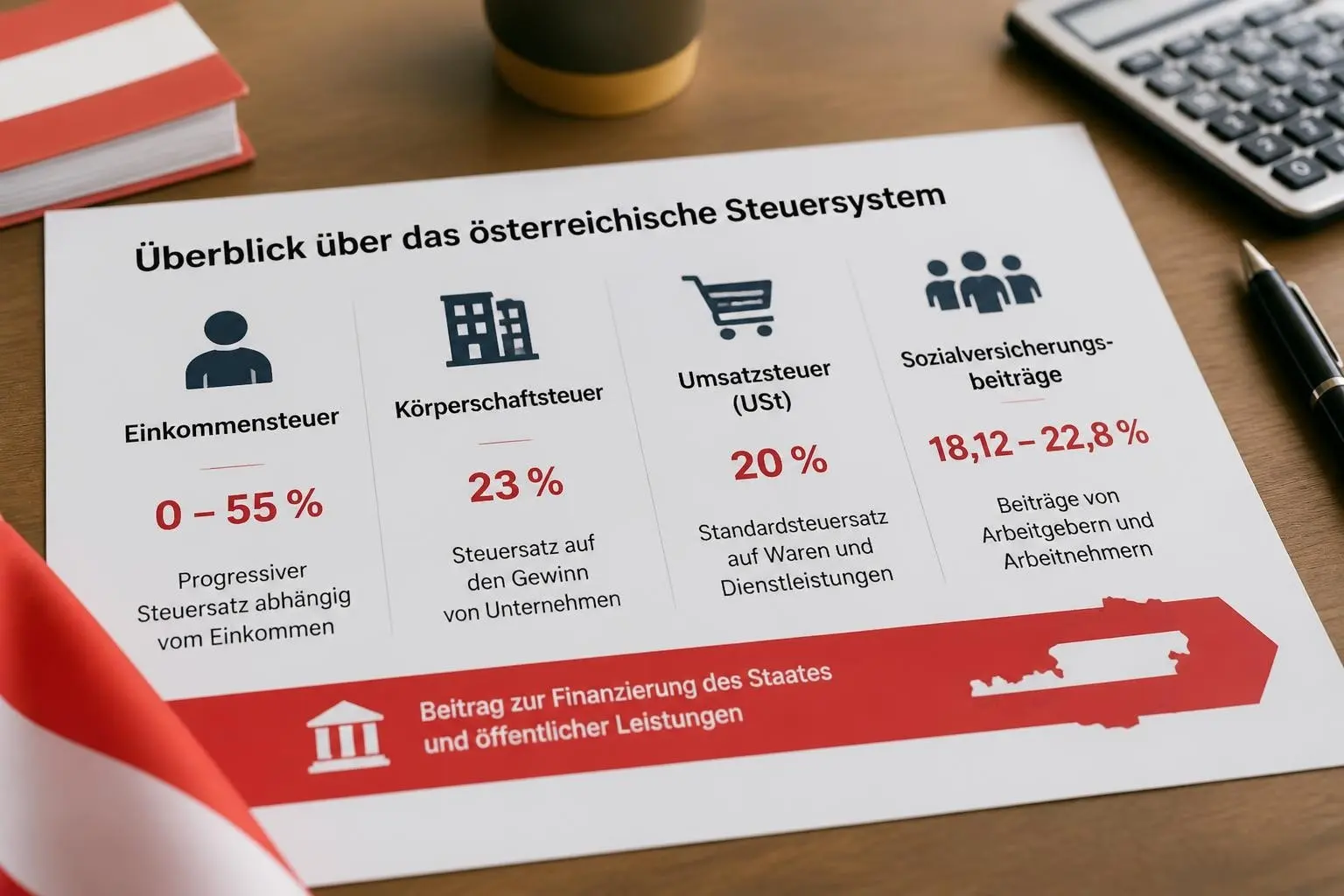
- ✛Income tax is progressive with rates from 0 to 55%. Since 2024 the brackets are 20, 30, 40, 48 and 50%; the top rate of 55% applies from EUR 1m.
- ✛Corporate tax has been 23% since 2024, no longer 24%. Distributions are also subject to 27.5% capital gains tax – about 44.2% in total.
- ✛The small business threshold has been EUR 55,000 gross turnover since 2025. VAT returns are due on the 15th of the second following month.
- ✛The self-employed receive a basic allowance of 15% on profits up to EUR 33,000. The investment allowance is raised to 20% or 22% for purchases from November 2025 to the end of 2026.
- ✛Anyone leaving Austria must consider exit taxation on capital assets and business assets. There has been no inheritance or gift tax since 2008.
The Austrian tax system at a glance
Austrian taxes are almost entirely levied by the federal government and administered by the Austrian Tax Office and the Tax Office for Large Enterprises. Provinces and municipalities receive their share through fiscal equalisation; their own levies are mainly municipal tax and property tax. According to Statistics Austria, the largest revenues come from wage and income tax, VAT and social security contributions.
| Tax | Rate 2026 | Note |
|---|---|---|
| Income tax | 0–55% | progressive, zero band up to about EUR 13,500 |
| Corporate tax (KöSt) | 23% | minimum tax EUR 500 per year for a GmbH |
| Capital gains tax (KESt) | 27.5% | 25% on bank interest |
| VAT | 20% | reduced 13% and 10% |
| Real estate gains tax | 30% | old assets flat 4.2% or 18% |
| Inheritance and gift tax | none | abolished in August 2008; real estate transfer tax remains |
On top of this come high payroll costs. For entrepreneurs, the overall burden of taxes and contributions matters more than any single rate. Comparisons with neighbouring countries are in our articles on taxes in Switzerland and taxes in Spain.
Income tax: 2026 rates
Anyone with a residence or habitual abode in Austria is fully taxable (section 26 BAO); a habitual abode exists at the latest after six months. Since 2023 the brackets have been adjusted annually for inflation – for 2026 only partially, because of budget consolidation.
| Annual income | Marginal rate |
|---|---|
| up to EUR 13,539 | 0% |
| EUR 13,539 – 21,992 | 20% |
| EUR 21,992 – 36,458 | 30% |
| EUR 36,458 – 70,365 | 40% |
| EUR 70,365 – 104,859 | 48% |
| EUR 104,859 – 1m | 50% |
| above EUR 1m | 55% (until 2029) |

The actual burden is reduced by tax credits such as the commuter credit, the sole earner and single parent credits and the Family Bonus Plus of up to EUR 2,000 per child per year. The 13th and 14th month salaries are taxed at favourable rates of 6% to 36% up to one sixth of annual pay.
Investment income: KESt
Dividends, gains on shares and funds and cryptocurrencies are taxed at a special rate of 27.5%. Interest on bank deposits is taxed at 25%. At Austrian banks the tax is withheld directly as a final tax. Income at foreign banks must be declared in the tax return. Austria receives this data through automatic exchange of information (CRS); from 2027 crypto data under CARF and DAC8 will be added.
Corporate tax and profit distributions
Companies with their seat or place of management in Austria pay corporate tax on their worldwide profit. As part of the eco-social tax reform, the rate was cut from 25% to 24% (2023) and 23% (since 2024).
- ✛Minimum tax: EUR 500 per year for a GmbH and FlexCo, even in a loss year; it is credited later. Newly formed companies pay less in their first quarters.
- ✛Minimum share capital: EUR 10,000 since 2024, of which at least EUR 5,000 paid in cash.
- ✛Loss carryforward: unlimited in time, but each year only up to 75% of total income can be offset.
- ✛Group taxation: profits and losses can be offset between companies linked by a financial interest of more than 50%, including losses of foreign subsidiaries in EU states and states with mutual assistance.
- ✛International participation exemption: dividends and capital gains from holdings of at least 10% in foreign companies, held for at least one year, are tax-exempt.
Overall burden on distribution
If the GmbH distributes its profit to an individual, a further 27.5% KESt applies. From EUR 100 profit, EUR 77 remain after 23% corporate tax; after KESt about EUR 55.8 remain. The overall burden is therefore about 44.2% – slightly less than the top rate for sole traders. How a GmbH can be used as a holding company is explained in our article on GmbH taxes.
Pillar Two
With the Minimum Taxation Act, Austria implemented the 15% global minimum tax from 2024, including a domestic top-up tax (QDMTT). Only groups with revenue of EUR 750m or more are affected. The Deloitte tax highlights give a compact overview of the implementation.
VAT
VAT is charged on almost all domestic supplies of goods and services. Businesses deduct input VAT from purchase invoices.
| Rate | Application (selection) |
|---|---|
| 20% | standard rate for most goods and services |
| 13% | accommodation, cultural events, domestic air passenger transport, live animals, plants, firewood |
| 10% | food, books and e-books, newspapers, passenger transport, residential letting, restaurant food |
| exempt | intra-EU supplies and exports (with input VAT deduction) |
Intra-EU supplies are not a separate rate but exempt supplies with input VAT deduction. They require a valid VAT number of the customer and an EC sales list. For distance sales to consumers in other EU states, the One-Stop Shop (OSS) applies from EUR 10,000. The European Commission publishes comparative data on VAT burdens in the EU.
Small business exemption
Since 2025, businesses with annual turnover of no more than EUR 55,000 gross are exempt from VAT. If the threshold is exceeded by no more than 10%, the exemption still applies until the end of the year. Since 2025, small businesses can also use the exemption in other EU states through the EU SME scheme. The downside: no input VAT can be deducted. The exemption can be waived, which binds for five years.
Tax planning for companies and the self-employed
Austrian tax law offers several statutory instruments that can significantly reduce the burden.
| Instrument | Benefit 2026 | Requirements |
|---|---|---|
| Profit allowance | basic allowance 15% on profits up to EUR 33,000; above that investment-linked 13%, 7% and 4.5% | individuals with business income; above EUR 33,000 investment in qualifying assets or securities |
| Investment allowance | 20% of acquisition costs, 22% for green investments (instead of 10% or 15%) | purchase between 1 November 2025 and 31 December 2026, maximum EUR 1m investment per year |
| Research premium | 14% of research expenditure, paid out as a credit | expert opinion of the Austrian Research Promotion Agency (FFG) |
| Group taxation | offsetting profits and losses within the group | holding of more than 50%, group application, minimum three years |
| Declining-balance depreciation | up to 30% per year | for many movable assets, not buildings or vehicles with CO₂ emissions |
Partners in partnerships also receive the profit allowance. Switching from a sole proprietorship to a GmbH usually pays off from about EUR 80,000 to 100,000 annual profit, if part of the profit stays in the company. The basics of GmbH taxation are explained in our article on taxes for a GmbH.
Have your tax structure in Austria and abroad reviewed – with company formation, bank account and accounting from one source.
Tax optimisation →Real estate: gains tax, transfer tax and property tax
Gains from the sale of real estate have been subject to real estate gains tax (ImmoESt) of 30% since April 2012. The notary usually calculates and pays it directly.
- ✛New assets (acquired from 1 April 2002): 30% on the gain, i.e. proceeds minus acquisition and construction costs.
- ✛Old assets (acquired before 1 April 2002): flat 4.2% of the sale price; 18% if rezoned after 1987.
- ✛Main residence exemption: tax-free if the home was used as the main residence continuously for at least two years from acquisition, or for at least five of the last ten years, and is given up.
- ✛Builder's exemption: for self-built buildings that were not let.
Real estate transfer tax
On a purchase, real estate transfer tax is 3.5% of the consideration, plus a 1.1% land register fee. For gratuitous transfers and within the family, a tiered rate applies to the property value: 0.5% up to EUR 250,000, 2% on the next EUR 150,000 and 3.5% above. Property tax is levied by municipalities on outdated assessed values and is usually low.
Inheritance, gifts and private foundations
Austria has not levied inheritance or gift tax since 1 August 2008. Gifts must, however, be reported to the tax office above certain limits: EUR 50,000 within one year between relatives, EUR 15,000 within five years between others. Failure to report can lead to a fine of up to 10% of the value.
- ✛Real estate transfer tax on transfers of property under the tiered rate
- ✛Foundation entry tax of 2.5% on contributions to private foundations; 25% if the foundation is not transparent or does not disclose documents
- ✛Interim tax of 23% on certain investment income of the private foundation, credited on later distribution
How asset structures in the EU are becoming transparent is shown in our article on the EU asset register.
Deadlines 2026
| Obligation | Deadline |
|---|---|
| VAT return (UVA) | monthly, quarterly if prior-year turnover up to EUR 100,000; due on the 15th of the second following month (e.g. January on 15 March) |
| Wage tax, employer contribution, surcharge | 15th of the following month |
| Municipal tax | 15th of the following month; annual return by 31 March of the following year |
| Income, corporate and VAT returns 2025 | 30 April 2026 on paper, 30 June 2026 via FinanzOnline |
| With a tax adviser (quota system) | generally by 31 March or 30 April of the second following year |
| Income and corporate tax prepayments | quarterly on 15 February, 15 May, 15 August and 15 November |
If a tax is not paid by the due date, a late payment surcharge of 2% applies, plus a further 1% each for continued delay. Interest on back payments and credits from assessments applies from October of the following year. SWICOR handles ongoing accounting and timely filing under accounting and tax.
FinanzOnline and digital processing
FinanzOnline is the portal of the Austrian tax administration. Businesses must file electronically where reasonable. FinanzOnline can be used, among other things, to:
- 1file tax returns and VAT returns
- 2access assessments and the tax account
- 3apply for a tax number and VAT number
- 4view payslips, prepayments and refunds
- 5communicate with the tax office via the databox
For employees without other income, the tax office has carried out automatic employee assessments since 2017 when a refund results. Since 2016, a cash register obligation has applied from EUR 15,000 annual turnover, of which more than EUR 7,500 is in cash.
International aspects: treaties, emigration and transfer pricing
Austria has concluded around 90 double tax treaties, including with Germany, Switzerland, Liechtenstein and Spain. Business profits are generally taxed in the state of residence unless there is a permanent establishment in the other state. For dividends, interest and royalties, the treaties usually provide reduced withholding taxes.
Exit taxation
Moving away from Austria can trigger tax on hidden reserves even without a sale (section 27(6) and section 6 no. 6 EStG):
- ✛Capital assets such as shares, funds and GmbH shares: on a move to an EU or EEA state with comprehensive mutual assistance, tax is not assessed on application until an actual sale. On a move to a third country, including Switzerland, it is due immediately.
- ✛Business assets: on a transfer to the EU or EEA, the tax can be paid in five annual instalments on application.
- ✛Return: anyone who moves back within ten years can have the tax corrected.
The same logic applies in Germany with German exit taxation and the exit tax under section 6 AStG. What else to consider when moving abroad is covered in our article on emigrating.
Foreign companies and CFC rules
Since 2019, Austria has attributed passive income of low-taxed foreign subsidiaries (effective burden up to 12.5%) to the Austrian parent company (section 10a KStG). If a foreign company is actually managed from Austria, it is fully taxable here. How this works in practice is shown in our article on permanent representatives and CFC taxation.
Transfer pricing
Transactions between related parties must be at arm's length. Under the Transfer Pricing Documentation Act, groups with revenue of EUR 50m or more prepare a master file and local file, and groups of EUR 750m or more also a country-by-country report.
For international businesses, an account outside the EU can diversify the banking structure. A bank account in Georgia, for example, offers multi-currency accounts and fully remote processing. We compare jurisdictions for foreign companies in UK LLP vs Hong Kong vs EU and taxes in Malta.
Tax audits and appeals
The tax administration audits businesses through external audits and the joint audit of payroll taxes (PLB). Typical focal points are:
- ✛proper bookkeeping and cash register records
- ✛appropriateness of transfer prices and managing director remuneration
- ✛correct VAT, especially for intra-EU transactions
- ✛private use of vehicles and business assets
- ✛hidden profit distributions
An appeal against an assessment can be lodged with the tax office within one month. If the tax office issues a preliminary appeal decision, a request for referral to the Federal Fiscal Court (BFG) can be filed within one month. After that, appeals to the Supreme Administrative Court and the Constitutional Court are possible.
Current changes 2025 and 2026
- ✛Budget consolidation: the inflation adjustment of the brackets is smaller in 2026; the top rate of 55% was extended until 2029.
- ✛Climate bonus abolished: the compensation for CO₂ pricing was scrapped from 2025; CO₂ pricing itself moves into the EU ETS 2 in 2027.
- ✛Investment allowance doubled: 20% or 22% for purchases from November 2025 to the end of 2026.
- ✛Small business threshold: EUR 55,000 gross since 2025 with an EU-wide option.
- ✛Banking and energy sectors: higher stability levy and extended energy crisis contribution as part of budget consolidation.
- ✛Transparency: automatic exchange of account information; from 2026 data collection by crypto service providers under DAC8.
As of October 2026. Further adjustments are to be expected as budget consolidation continues.
Conclusion
Austrian taxes are high in 2026 but can be planned well. Knowing the brackets, the combined burden of GmbH and KESt, the profit allowance, the increased investment allowance and the deadlines allows the burden to be reduced significantly. International activity adds treaties, exit taxation and CFC rules.
SWICOR . SWISS CORPORATE SOLUTIONS supports you with international structures – from company formation and the bank account to tax optimisation and residency abroad, fully remote and at transparent fixed prices.
Frequently asked questions
How high is income tax in Austria in 2026?
The scale is progressive: 0% up to about EUR 13,500, then 20, 30, 40, 48 and 50%. Income above EUR 1m is taxed at 55% until 2029.
How high is corporate tax in Austria?
Since 2024 it has been 23%. Together with 27.5% KESt on distributions, the overall burden is about 44.2%.
How high is capital gains tax?
27.5% on dividends, capital gains and cryptocurrencies, 25% on bank interest.
From what turnover does the small business exemption no longer apply?
Since 2025, from annual turnover of more than EUR 55,000 gross. Exceeding it by no more than 10% is tolerated once.
Is there an inheritance tax in Austria?
No, not since August 2008. However, real estate transfer tax applies to property, and gifts must be reported above certain limits.
When must the tax return be filed in Austria?
By 30 April on paper or by 30 June via FinanzOnline. With a tax adviser, the deadline generally extends into the second following year.
Reduce your tax burden in Austria?
We review your structure, compare alternatives abroad and implement the right solution – remotely and at fixed prices.
This article is a general analysis and does not replace individual tax or legal advice. Regulations change; the information reflects the status at the date of publication.
Social security and payroll costs
Social security contributions are not taxes but shape the overall burden. They are levied up to a maximum contribution base that is adjusted annually.
Employers also pay payroll levies on total wages: the employer contribution to the family burden equalisation fund (3.7%), the surcharge on the employer contribution (about 0.3 to 0.4% depending on the province) and municipal tax (3%). Employers thus bear about 29 to 30% on top of gross pay.
The self-employed are insured with the social insurance institution for the self-employed (SVS) and pay about 27% of their income for health and pension insurance and self-employed provision, plus a fixed accident insurance contribution. Shareholder-managing directors with a stake of more than 25% are usually also insured with the SVS.